
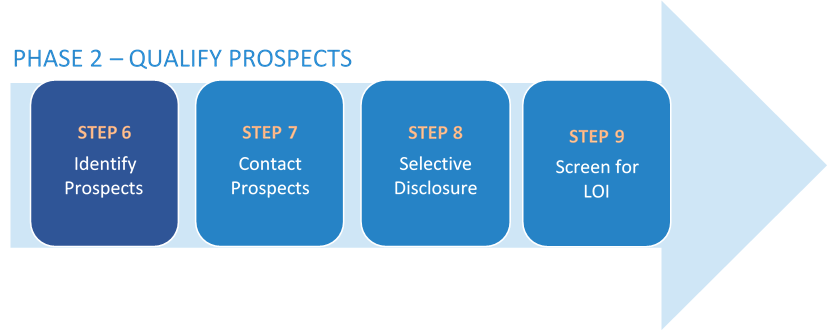
Identify and Rank Prospective Purchasers
Identifying Prospective Buyers
The process of identifying buyers begins with an assessment of the different types of buyers you might consider and seeing how well they match up with the objectives you identified in Step 1 for selling your business. However, you should know that 33% of all the sales in the Middle Market occur because of an unsolicited offer to buy a company – so for many sellers, this Step 6 may be unnecessary.
- Strategic Buyers – in general you should
expect that a strategic buyer will pay more for your company that a financial
buyer. Strategic buyers usually “want or need” your company to advance their
own company objectives. In many cases you already know these potential buyers
because they are your suppliers, customers or competitors. Examples of
strategic buyers include companies with:
- Complementary products, services and/or distribution channels
- Similar businesses – with different geography
- Part of your “food chain”
- Competitors (which you must approach with caution)
- Financial Buyers – These usually consist
of family offices and private equity firms. In most cases they are making a
purchase of your company to achieve a targeted financial return. Some of the
characteristics of financial buyers are:
- They are financial engineers – allegedly “smart money” knowing what operating adjustments are needed, when to buy and sell to maximize return
- These types of purchases are usually cash, but you must be careful of complex purchase structures
- Primarily concerned with return on investment
- Usually plan to hold and sell again
- Due diligence is tougher because there is little of the leverage anticipated by a strategic buyer who can gain efficiencies with the purchase
Sometimes a financial purchaser behaves more like a strategic buyer when a private equity firm makes the purchase as part of a plan for expansion in a particular market sector. This would include buying your company to create a platform, bolt-on, or roll-up.
Last, there are always exceptions to the strategic and financial purchaser motivations when there is an unusual fit (customer base, sales channels, needed technology, new market opportunity, superior management team) or circumstances (replacement of market position due to required divestiture or conflict of interest).
Value is Driven by a Range of Dynamics
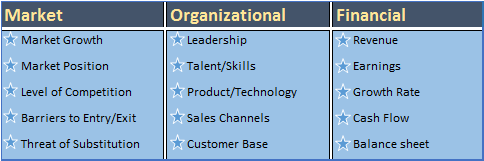
Once again, selecting target buyers will be a function of matching your objectives for selling your company (Step 1) with the range of strategic and financial buyers you can identify. Your priority buyers will be those that match up well with your specific objectives. You probably already know most of the high priority strategic buyers because you do business with them – or you compete with them.
Qualifying the Buyer – Top 10 Questions
- Why are you interested in my company?
- What acquisitions has your company done?
- What is your preferred deal structure?
- What is your approval process?
- Who is involved in the decision?
- How do you see our company fitting into yours?
- What’s your integration process?
- Who are your outside advisors?
- How did your acquisitions work out?
- Can I talk to companies you have acquired?
There are many industry-by-industry directories available to you to expand your list of strategic buyers beyond those you may know personally. The same is true for financial buyers. If you google “Directory of Private Equity Firms” or “Directory of Family Offices” you will find an ample supply of references describing the types of industries and company sizes sought by these investors. The directories will also provide contact information.
Through the PQ Community you may also work through our resources which include on-line buyer prospecting tools, Accountants, Lawyers and the expertise of investment bankers. PQ can provide a list of preferred third-party advisors for Step 6.
Contact Us at any time for help or to provide feedback.